Automation in overmolding is rapidly transforming overmolding production lines. As product designs become more complex and quality requirements continue to rise, manual overmolding operations struggle to keep pace with modern manufacturing demands.
Automation offers a reliable solution by improving process stability, reducing labor dependency, and increasing overall production efficiency.
In this article, we explore how automation is applied in overmolding production lines, the key technologies involved, the benefits and challenges of implementation, and best practices for manufacturers looking to scale overmolding operations with consistent quality and cost control.
Why Automation Matters in Overmolding
Overmolding is inherently more complex than single-material injection molding. It involves multiple materials, precise part positioning, and strict process control to ensure strong adhesion and dimensional accuracy.
Manual handling introduces variability, including:
- Misalignment of substrates
- Inconsistent cycle times
- Contamination at bonding surfaces
- Higher scrap rates
Automation addresses these issues by delivering repeatable, controlled, and data-driven production.
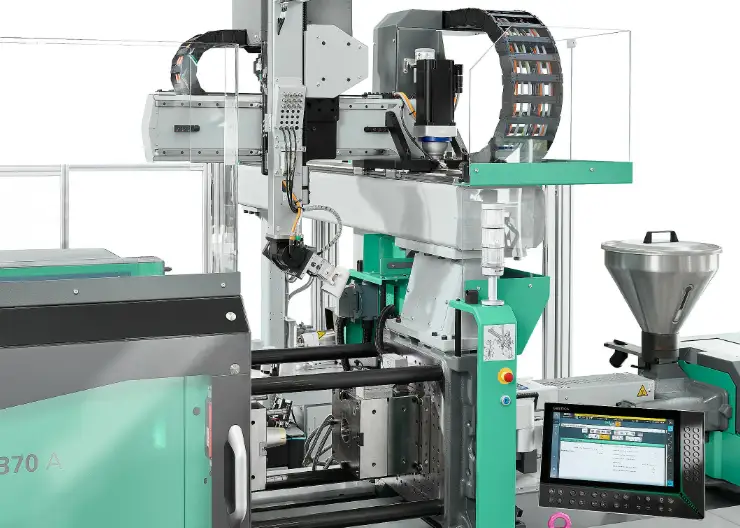
Core Automation Elements in Overmolding Production Lines
An automated overmolding production line integrates several key components working together as a system.
Automated Part Handling and Transfer
One of the most critical automation steps in overmolding is transferring the substrate from the first molding stage to the overmolding station.
Robotic Pick-and-Place Systems
Industrial robots are used to:
- Remove substrates from the first mold
- Orient parts accurately
- Place them precisely into the overmolding cavity
Robotic handling minimizes part damage and ensures consistent positioning, which is essential for reliable bonding.
Benefits of Automated Transfer
- Reduced cycle time
- Improved alignment accuracy
- Lower risk of contamination
- Consistent repeatability
This is especially important in two-shot and transfer overmolding processes.
Automation in Two-Shot Overmolding
Two-shot overmolding machines are often highly automated by design.
Rotary and Indexing Mold Systems
These systems automatically rotate or index the mold between shots, eliminating the need for manual part handling.
Key advantages include:
- Perfect part alignment
- Shorter cycle times
- Improved bonding consistency
Two-shot automation is ideal for high-volume, high-precision overmolding applications.
Automated Insert Loading in Overmolding
For insert and transfer overmolding, automation ensures accurate and repeatable insert placement.
Automated Insert Feeding Systems
These systems:
- Feed inserts from magazines or conveyors
- Verify orientation and position
- Place inserts into molds with precision
Automation prevents common issues such as misplacement, part damage, or cycle interruption.
In-Mold Automation and Process Monitoring
Automation in overmolding extends beyond handling—it includes real-time process control.
Sensors and Monitoring Systems
Modern overmolding lines use sensors to monitor:
- Temperature
- Injection pressure
- Mold position
- Cycle time
This data ensures stable bonding conditions and early detection of process deviations.
Vision Inspection Systems
Automated vision systems inspect:
- Part placement
- Overmold coverage
- Cosmetic defects
Vision inspection reduces reliance on manual checks and improves quality consistency.
Quality Control Automation in Overmolding
Quality control is a major focus of automated overmolding production lines.
Automated Inspection
- Dimensional checks
- Bond line inspection
- Flash and short-shot detection
Automated inspection systems allow immediate feedback and corrective action.
Data Collection and Traceability
Automation enables:
- Part-level traceability
- Statistical process control (SPC)
- Digital quality records
This is especially important in medical, automotive, and electronics industries.

Productivity and Cost Benefits of Automation
Automation significantly improves productivity and cost efficiency.
Key Benefits
- Reduced labor costs
- Higher production throughput
- Lower scrap rates
- More consistent part quality
- Predictable cycle times
While automation requires upfront investment, it often delivers a strong return over the long term.
Automation Challenges in Overmolding Production
Despite its advantages, automation in overmolding presents challenges.
High Initial Investment
Robots, sensors, and control systems increase capital expenditure.
Integration Complexity
Automation must be carefully integrated with:
- Injection molding machines
- Tooling
- Material handling systems
Poor integration can create bottlenecks instead of efficiency.
Part Design Constraints
Not all parts are automation-friendly. Complex geometries may require custom end-of-arm tooling or special fixtures.
Best Practices for Implementing Automation in Overmolding
Successful automation starts with planning.
Start with Process Stability
Automating an unstable process only amplifies problems. Ensure:
- Proven materials
- Stable tooling
- Repeatable process parameters
Design Parts for Automation
Automation-friendly design includes:
- Consistent part orientation
- Robust handling features
- Clear datum points
Scale Automation in Phases
Begin with:
- Automated part transfer
- Vision inspection
Then expand to full line automation as volume increases.
Industry Applications of Automated Overmolding
Medical Device Manufacturing
Automation supports:
- Cleanroom requirements
- Traceability
- High consistency
Automotive Production
Automation ensures:
- Tight tolerances
- High volume output
- Long-term reliability
Electronics and Industrial Tools
Automation improves:
- Bonding consistency
- Throughput
- Cost control
Future Trends in Overmolding Automation
The future of overmolding automation includes:
- AI-driven process optimization
- Smart factories and Industry 4.0 integration
- Increased use of collaborative robots (cobots)
These trends will further improve efficiency and flexibility.
Choosing the Right Automation Partner
Selecting the right partner is critical.
What to Look For
- Experience in overmolding automation
- Strong process engineering support
- Custom automation capability
- Proven integration expertise
The right partner helps reduce risk and maximize ROI.
Conclusion: Automation Is the Future of Overmolding Production
Automation in overmolding production lines is no longer optional for manufacturers seeking efficiency, consistency, and scalability.
By reducing manual handling, improving process control, and enabling real-time quality monitoring, automation transforms overmolding into a predictable, high-performance manufacturing process.
Manufacturers that invest in smart automation today are better positioned to meet rising quality standards, control costs, and scale production with confidence.